Your Workers’ Comp Claim and Your Injury Claim Are Not the Same Thing
Picture this: You’re sitting at your kitchen table after a twelve-hour shift, staring at a letter from your employer’s insurance company. The language is dense. There are references to “indemnity benefits” and “subrogation rights” and something about a recorded statement they’d like to schedule. Your shoulder is still throbbing from the fall last week. You don’t know if you should sign anything, call anyone, or just wait.
That moment—that specific kind of confusion—is exactly why I write. Because I’ve watched too many injured workers make decisions in that fog that quietly cost them thousands of dollars and months of medical care they deserved.
What You’re Actually Dealing With: Two Different Systems
Most injured workers assume there’s one process. You get hurt, you report it, someone pays your bills.
The reality is more complicated. Understanding the difference between your workers’ compensation claim and a potential personal injury claim may be the single most important thing you do in the weeks after a workplace accident.
| Workers’ Compensation | Personal Injury Claim | |
|---|---|---|
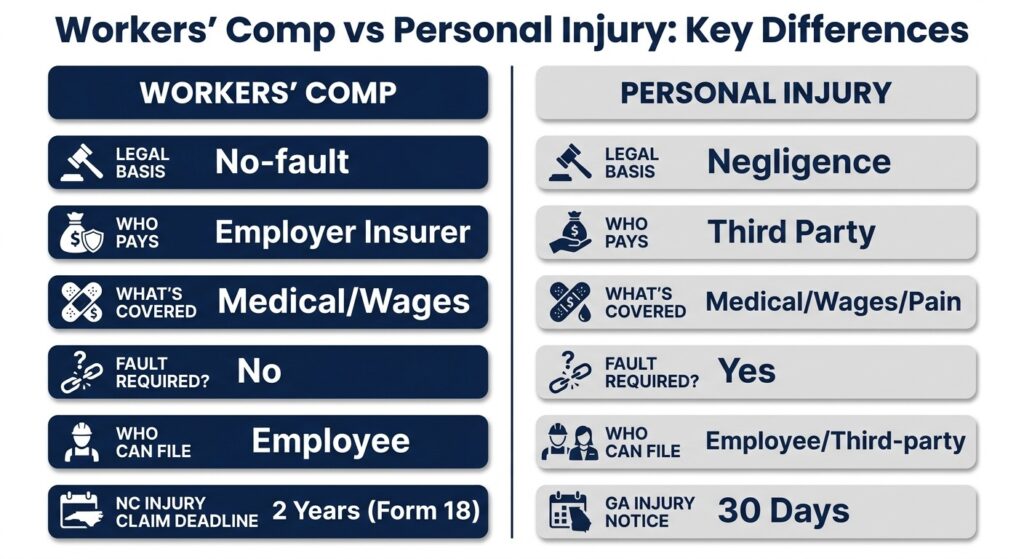
| Legal basis | No-fault system | Negligence |
| Who pays | Employer’s insurer | At-fault third party |
| What’s covered | Medical bills, partial wage loss | Medical bills, lost wages, pain and suffering, emotional distress, future earning capacity |
| Fault required? | No | Yes |
| Who can file | Any injured employee | Employees injured by a third party |
Workers’ compensation is a no-fault system—its defining feature. Your employer carries insurance, and if you’re injured on the job, that system is supposed to cover your medical treatment and a portion of your lost wages, regardless of who caused the accident. You don’t have to prove your employer was careless. You just have to prove you were injured while working.
A personal injury claim operates on an entirely different legal foundation: negligence. Someone has to be shown to have acted carelessly, and that carelessness has to be the reason you were hurt. Workers’ comp settlements are generally lower because they’re capped at wage loss and medical benefits. A personal injury claim can include the full human cost—pain and suffering, loss of enjoyment of life, emotional distress, future earning capacity.
So when can you pursue both? When a third party—someone other than your employer—contributed to your injury. A forklift manufacturer whose equipment failed. A subcontractor whose crew created the hazard. A delivery driver who caused a vehicle accident while you were on the clock. These third-party claims run parallel to workers’ comp, and that’s where a personal injury attorney becomes essential.
How a Personal Injury Attorney Actually Builds Your Case
Here’s what most law firm websites skip: the mechanics. What does an attorney actually do after you walk in the door?
Understanding the process helps you understand why certain decisions you make in the first days after an injury matter so much.
1. The investigation starts immediately. A good attorney doesn’t wait for paperwork to settle. They want the incident report before it gets amended, photographs of the scene before conditions change, and witness names before memories fade or people move on to other job sites. Surveillance footage is especially time-sensitive—many systems overwrite automatically within days.
2. Medical records become the backbone of your claim. Your attorney will gather every record—emergency room notes, imaging results, specialist evaluations, physical therapy progress notes—and use them to build a timeline connecting the accident to your injuries. Insurance companies look for gaps. If you waited two weeks to see a doctor, they’ll argue your injury wasn’t serious or wasn’t caused by the workplace accident. Consistent, documented medical care tells a different story.
3. Wage documentation fills in the economic picture. Pay stubs, tax records, employer documentation of your regular hours and earnings. In cases where an injured worker cannot return to their previous role, settlement value reflects that long-term economic impact—but only if the documentation exists to prove it.
4. Liability investigation runs alongside everything else. For a third-party negligence claim, your attorney needs to establish who owed you a duty of care, how they breached it, and how that breach caused your specific injuries. That might involve engineering experts, OSHA violation records, equipment maintenance logs, or accident reconstruction specialists. None of this happens automatically.
A skilled boston personal injury attorney approaches this the same way a good investigative journalist would—following every thread, preserving every document, and building a factual record that holds up under pressure from an insurance company’s defense team.
The Timeline Problem
This is where I get quietly urgent.
I’ve seen people lose legitimate claims not because they lacked evidence, but because they missed a deadline they didn’t know existed.
North Carolina has specific notice and filing requirements for workers’ compensation claims. You must report your injury to your employer promptly—delays create openings for the insurance company to dispute whether the injury actually happened at work. Form 18, the official notice of accident, must be filed with the North Carolina Industrial Commission within two years of the injury date. Miss it, and you may lose your right to benefits entirely.
Third-party personal injury claims have their own statute of limitations, separate from the workers’ comp deadline. These timelines don’t pause while you’re waiting on a workers’ comp decision.
A note on how other states handle this:Worker-focused legal guidance notes that in Georgia, injured workers must notify their employer within 30 days of the injury or risk jeopardizing the claim—and filing deadlines for workers’ compensation claims generally run one year from the accident date, with extensions possible if benefits were already received. North Carolina’s rules differ, but the underlying lesson is identical: these systems have hard cutoffs, and they don’t bend for confusion or delay.
The practical implication is stark. The moment you’re injured is the moment your legal clock starts. Reporting the injury, seeking medical care, and consulting with an attorney aren’t things you do when you feel ready. They’re things you do as quickly as possible, because delay is one of the few things that can genuinely destroy an otherwise valid claim.
What Proof Actually Looks Like
Let me walk through what a well-built case actually contains—because knowing this helps you understand what to protect and what to document yourself.
Incident reports and employer records. Your employer is required to document workplace accidents. Get a copy of whatever they file. If the report contains inaccuracies—and sometimes they do, especially when an employer is nervous about liability—your attorney needs to know immediately.
Medical records and treatment consistency. Every appointment, every referral, every prescription. Your attorney will review these not just for diagnosis but for language—how your treating physician describes your limitations, your prognosis, and whether your condition is causally connected to the accident. That language matters in negotiations and at hearings.
Witness statements. Coworkers who saw what happened, or who can speak to the conditions that caused it, are valuable. People move on, memories shift, and some witnesses become reluctant to get involved. Statements taken early carry more weight.
Expert testimony. For serious injuries—spinal damage, traumatic brain injury, permanent disability—your attorney may retain medical experts, vocational rehabilitation specialists, or economists to quantify what you’ve lost and what you’ll continue to lose. This is especially important when an insurance company argues your injury is less severe than your doctors indicate.
Photographs and physical evidence. The broken rung on the ladder. The wet floor with no warning sign. The machine with the missing guard. These things get repaired, replaced, or removed. Documenting them early—or having your attorney send a preservation letter—can be the difference between having proof and having only your word.
Common Defenses You’ll Face—and Why They’re Not the End
Insurance companies don’t simply accept claims. They look for reasons to reduce or deny them.
Three defenses come up repeatedly, and understanding them helps you avoid inadvertently giving the other side ammunition.
Pre-existing conditions. If you have a history of back problems and you injure your back at work, the insurance company will argue the injury isn’t new. Your attorney counters this by showing how the workplace accident aggravated or accelerated a condition that was previously manageable—a distinction that matters legally.
Contributory negligence. North Carolina follows a strict contributory negligence rule. If you’re found even partially at fault for your own injury, it can bar your recovery in a negligence case entirely. This is one of the reasons having an attorney who understands how to frame the facts matters so much.
Recorded statements. The insurance company may contact you early and ask for a recorded statement about the accident. What you say—and how you say it—can be used to minimize your claim. You are generally not required to give a recorded statement to the other party’s insurer. Your attorney can advise you on this before you say anything.
The fear that one wrong step will cost you everything isn’t irrational. It’s grounded in how these systems actually work. But it’s manageable when you understand the rules.
Q&A: The Questions I Hear Most Often
Can I be fired for filing a workers’ comp claim? Retaliation for filing a workers’ comp claim is illegal in North Carolina. That doesn’t mean it never happens—but it does mean you have legal recourse if it does.
Do I need an attorney if my injury seems minor? Minor injuries sometimes become serious ones. And even in straightforward claims, having a consultation costs you nothing and tells you exactly where you stand.
What if my employer says I don’t qualify for workers’ comp? Employers sometimes dispute coverage. That dispute is exactly what the North Carolina Industrial Commission exists to resolve. An attorney can help you navigate that process.
Will I have to go to court? Most cases settle before trial. But the strength of your documented case is what creates the leverage that leads to a fair settlement.
What to Do Right Now
If you’re reading this after a workplace accident, the path forward is clearer than it probably feels.
Report the injury to your employer in writing if you haven’t already. Seek medical care and keep every appointment. Don’t give recorded statements to any insurance company without legal guidance. Gather whatever documentation you can—photos, incident reports, witness contact information.
Then talk to a personal injury attorney before you make any decisions about settlements or recorded statements. Most offer free consultations, and the conversation itself will help you understand whether you have a workers’ comp claim only, a third-party negligence claim, or both.
That distinction shapes everything that follows. You don’t have to decode it alone.